Trends in Custom PCB Fabrication
The world of printed circuit boards (PCBs) is experiencing a series of significant advancements that are reshaping the industry. From new materials to automation, these innovations are enabling greater efficiency, accuracy, and consistency in PCB manufacturing processes. As a result, manufacturers can now offer their customers advanced technologies that deliver better functionality and performance.
A major development impacting the future of custom PCB fabrication is the increasing adoption of 5G technology. The new connectivity standard requires PCBs to handle higher frequencies and data transfer rates than previous generations, requiring advanced materials and precise manufacturing techniques. In addition, 5G devices generate more heat, which creates the need for improved thermal management solutions in PCBs.
The Internet of Things (IoT) is also influencing PCB fabrication trends. This system of billions of worldwide devices with intricate sensors and software capabilities is transforming industrial processes and accelerating productivity in a variety of sectors. IoT-enabled devices require highly compact and power-efficient circuits, which is driving the demand for miniaturization in PCBs. This is facilitated by high-density interconnect (HDI) technology, which utilizes microvias, blind and buried vias, and fine lines and spaces to achieve greater wiring density in small spaces.
Advanced material selection is another important trend in custom pcb fabrication. Manufacturers are shifting away from traditional FR-4 materials to high-performance alternatives that provide greater flexibility and reliability in demanding applications. These new materials can handle high frequencies and withstand more heat, making them suitable for mission-critical systems such as telecommunications networks. They can also reduce signal loss and ensure superior trace signal integrity.
Future Trends in Custom PCB Fabrication
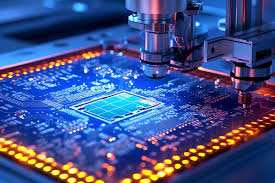
Other emerging trends in custom PCB fabrication include the use of automated assembly methods, which improve precision and efficiency while reducing human error. Automation is also allowing manufacturers to scale production up or down as needed, while also improving quality and consistency. Additionally, robotic inspection systems are enhancing the effectiveness of quality assurance (QA) by detecting even the most subtle defects with unparalleled speed and accuracy.
Another growing trend in custom PCB fabrication is the use of eco-friendly materials and processes. This movement is fueled by the rise of sustainability as a global priority and a focus on environmentally friendly production processes that limit energy consumption and chemical usage.
Finally, advanced simulation and modeling tools are enabling PCB designers to create more efficient and effective layouts. These tools allow designers to test and optimize the performance of their designs before production begins, resulting in improved reliability and efficiency. This also helps manufacturers avoid costly mistakes that can occur in the production process and decreases waste. In addition, on-demand manufacturing is allowing PCB manufacturers to produce smaller batches of boards to cater to specific requirements and reduce inventory costs. This allows them to be more responsive to customer demands and deliver customized products in a shorter time frame. This makes the future of custom PCB fabrication an exciting prospect for electronics manufacturers.