Here are a couple of recent outtakes from the business press:
Australia’s unemployment rate rose to 4.1% in June from 4% in May, despite the addition of 50,200 jobs, including 43,300 full-time positions. This data further fuels expectations of a Reserve Bank rate hike in August.
Federal Treasurer Jim Chalmers claims the government has created nearly 930,000 jobs since May 2022. Several economists advise that recent job growth is evaluated relative to labour market size, while Shadow Treasurer Angus Taylor attributes the job increase to population growth.
The Productivity Commission highlighted the challenge of boosting productivity in labour-intensive sectors like aged and disability care. According to the commission productivity in other industries will have to improve to combat the negative impact on productivity that will result from growth in the care sector.
My quip is that, yes there has been an increase in jobs, and many of them have been in full-time positions.
And I agree that labour productivity is in the toilet especially when it comes to government-aligned businesses.
It also pays dividends to understand that a full-time job as per the official statistics (ABS) is one which where an individual works 35 hours or more per week.
It does not matter if you hold one job or several, as long as you work over 35 hours per week, then you are deemed to be employed full-time.
Also, fewer people are working part-time or on a casual basis, because of changing labour laws, which are going to become even more challenging from late August.
Often ignored is the level of underemployment – those who are employed but would like to work more – which is 6.5% as of June this year according to the ABS, up by 0.5% on June 2023.
Moreover, it speaks volumes to understand what type of jobs have been created.
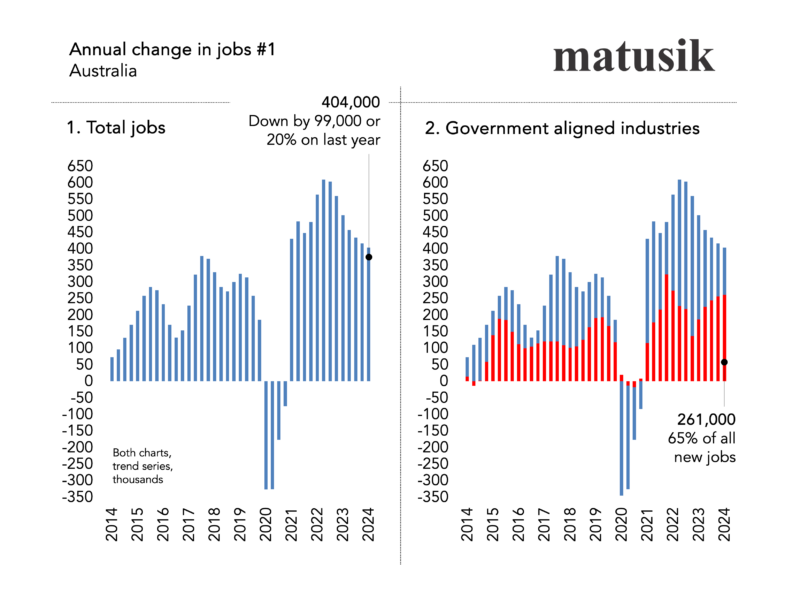
The government sector is booming at both state and federal levels.
In short, small business increasingly is being squeezed out by new regulations and competition from jobs paid for from the public purse.
Furthermore, the federal government is making it more expensive and difficult to do business in Australia.
Top of the list is a raft of changes to industrial relations laws that increase costs and reduce workplace flexibility.
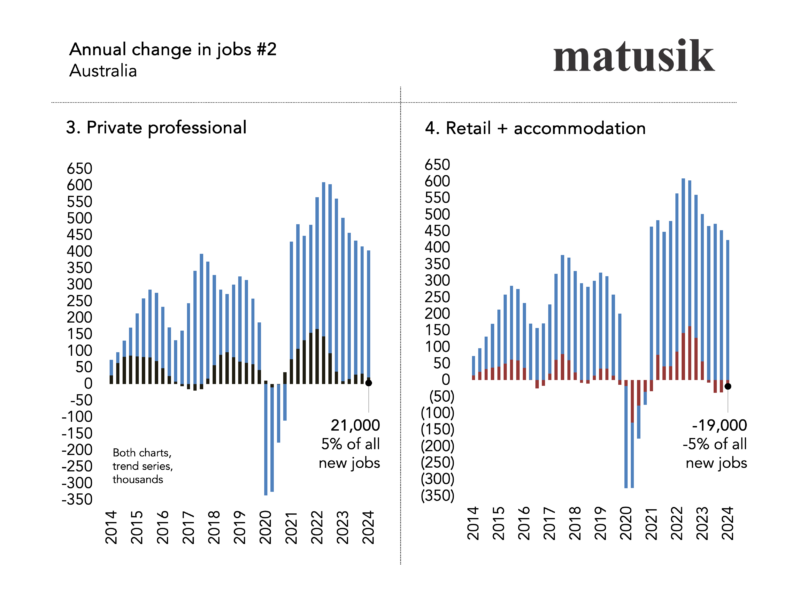
This is especially the case when it comes to the retail and hospitality sectors.
See chart 4.
And at every turn, the Labor government seems determined to pick winners in ways that make it more difficult for established industries.
The latest addition is Future Made which looks to boost local manufacturing.
Given the recent self-made roadblocks, good luck with that.
See chart 5.
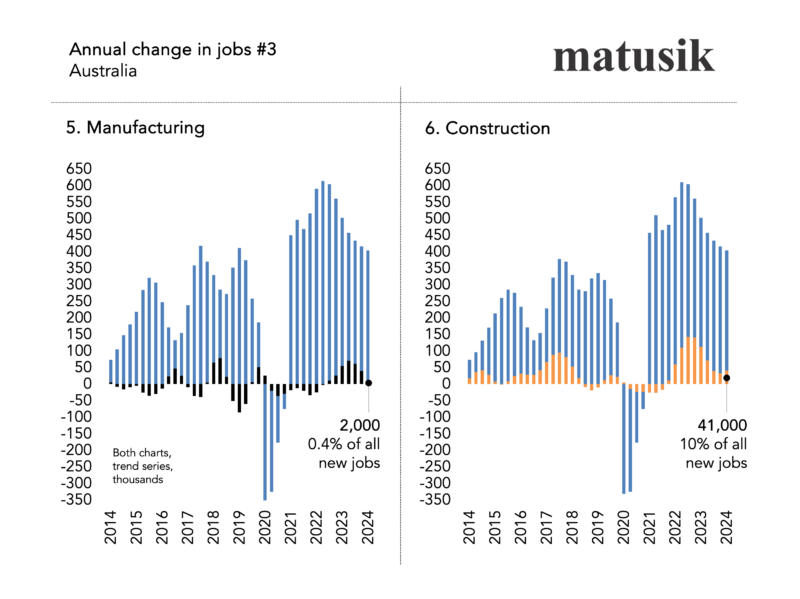
And when it comes to construction – which accounts for just over 7% of our economy and employs some 1.4 million Australians – is struggling when it comes to new job creation.
See chart 6.
Given the level of housing undersupply, one would expect job creation in the sector to be going gangbusters.
It isn’t just the lack of workers that is to blame, but tier-one builders going off to much better-paid government and civil projects.
Also, many of teir two builders who can step up to take on residential towers are being scared off by the significant potential of having to deal with an extremely emboldened union.
We cannot underestimate the negative impact that the CFMEU is having on project starts and new construction jobs.
So, it looks to me that the outlook for private businesses is uncertain at best – more realistically, worryingly weak – and our economic future demands immediate attention.
And that means the cash rate needs to remain on hold next week and they really need to start falling, several times, this side of Christmas.
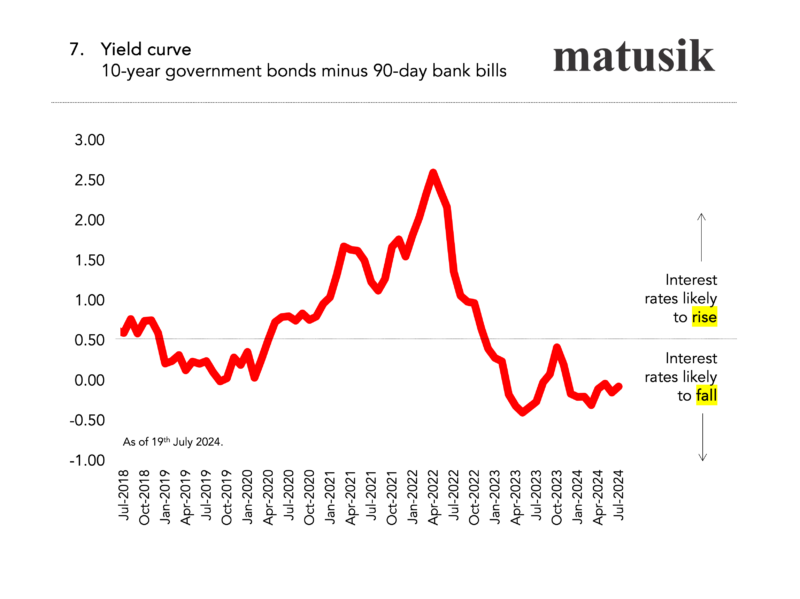
Chart 7 tells me – as of the 19th of July – that the financial markets, and despite the babble from the talking heads in recent weeks, think that interest rates are more likely to fall rather than rise in coming months.
Fingers crossed.